Woman In The Plural
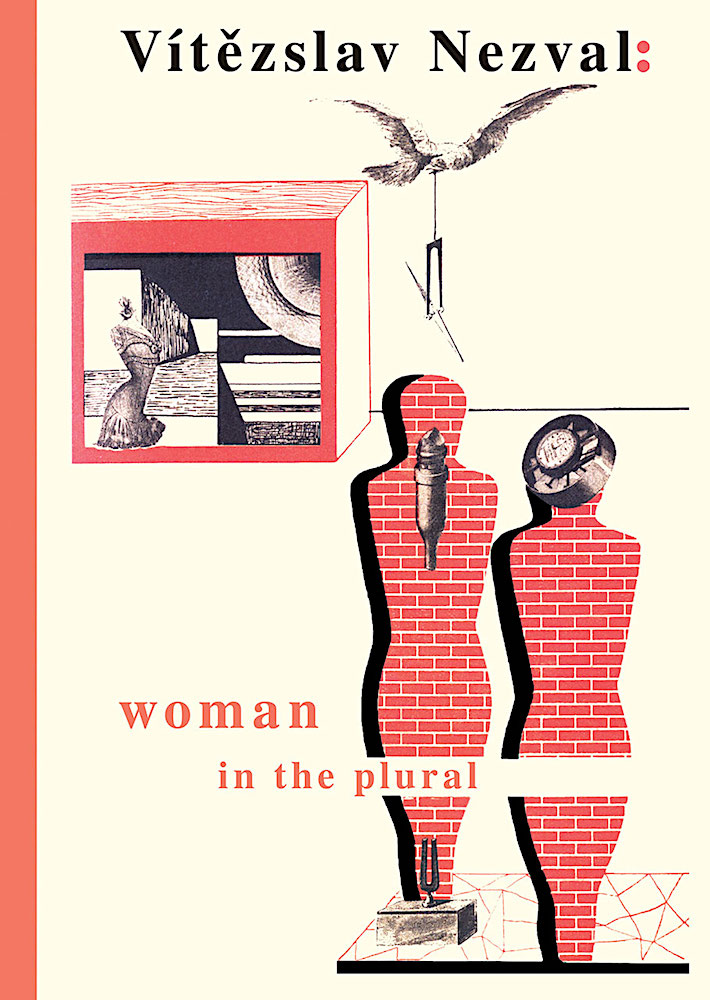
Woman In The Plural
In the summer of 1935, Vítězslav Nezval, already one of the most celebrated Czech poets of his generation, embarked on a period of manic creativity that would result in three volumes of poetry written and published in a two-year span (1935-37), mirrored by three volumes of memoir-like poetic prose. These collections would not only reshape Czech poetry, blending approaches developed by the French Surrealists with national cultural sensibilities and political concerns, taken together they are among the highest achievements of the interwar avant-garde. Woman in the Plural (1936), the first volume in this loose trilogy, adopted “objective chance” as its modus operandi (whereas the third and final volume, The Absolute Gravedigger (1937), was guided by the paranoiac-critical method).
Appearing in English translation for the first time, Woman in the Plural displays Nezval’s prodigious talents in a variety of forms, styles, and genres as he spins images of the female form like a zoetrope to create novel and hallucinatory ways of conceiving woman’s mythical, divine, and creative power. It is an eclectic collection that blends profound free verse, at times reading like a cascade of automatic writing, with pages from Nezval’s dream journal, an exuberant set of Surrealist exercises, and a full-length play of chance encounters with “a woman like any other,” all the while addressing the social and political uncertainties of the 1930s. Led off by Karel Teige’s original collages from the first edition, Woman in the Plural is a vibrant and volatile tour de force from one of the greatest European artists of the 20th century.
Tradução: Stephan Delbos; Tereza Novická
Editora: Twisted Spoon Press
ISBN: 9788086264561
Data de publicação: 2021
Encadernação: Capa dura
«Woman in the Plural, translated now for the first time in English, is a key contribution to the development of European surrealism. Fans of surrealism enjoy its effects on readers’ imaginations by juxtaposing concrete words that don’t usually appear together …» — Tom Bowden, Book Beat
«You really get a sense of Nezval’s love for women, and it is beautiful. It does not deify women or idealise them. Women appear as the stuff of dreams and fantasy but a fantasy that is edgy and highly experimental, even by today’s standards. These women come in ‘countless variations’, sometimes sweet but frequently antagonistic; they are feminists in a man’s world hastening in modernity ‘like the cocking of a rifle’s hammer’.» — Lucille Turner, Bookmunch
«I found this a fascinating collection of assorted pieces – prose, poetry, drama. The imagery is thoroughly surrealistic so do not look for any rational meaning. There isn’t any nor is there intended to be any. Indeed, that is what makes the collection so interesting.» — The Modern Novel
«This whole section [“Pages from a Diary”] is a snapshot of the european avant garde when everything was up for grabs, it was all to play for. They were writing to each other across the continent, hooking up, buying each other’s publications. In this section, the night-time dreams overlap with the accounts of daytime.» — Steve Hanson, Manchester Review of Books
«One of the most beautiful of Nezval’s collections and one of the most interesting books in the entire corpus of modern Czech poetry.» — Vilém Závada, Gazette for Art and Critique (1936)